Draw a Flag Accuracy Tips & Scoring Habits
Proportions, colors, emblems, and drills that raise Draw a Flag! duel scores.
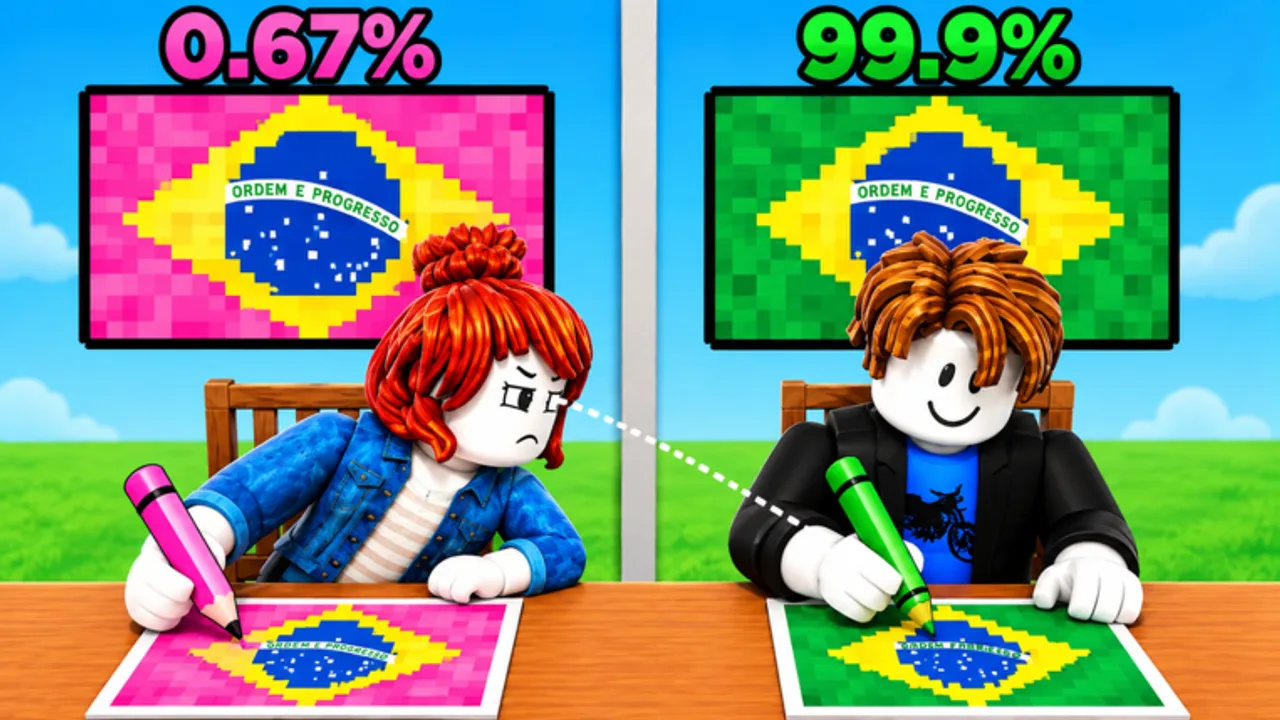
Accuracy is the score that decides Draw a Flag! duels. Meow Forge’s Roblox experience compares your pixel canvas to the real national flag and ranks you against an opponent on that metric. Style points in your head do not count. This page is a deep dive into what tends to raise or lower that comparison: proportions, color fidelity, emblem placement, edge hygiene, and practice routines you can run between matches.
If tools still feel awkward, read Controls first. For the shape-first workflow, use How to Draw Flags. For live decision-making under a timer, study How to Win. Beginners should still start at Getting Started.
What “accuracy” is optimizing for
Think of the grader as sampling regions across the flag. Large wrong areas hurt more than tiny edge noise. That means:
- Correct band counts and order beat fancy corners.
- Correct dominant colors beat elaborate but incomplete crests.
- Centered emblems in the right spot beat detailed emblems shifted off-center.
- Covered canvas beats tasteful blank space where color should exist.
Your job is to maximize overlap with the true design, not to invent a prettier variant.
Proportions: the silent score killer
Many players remember colors and still lose because band widths are uneven or a canton is too large. Before detailing, do a proportion check:
- Are horizontal stripes roughly equal when they should be?
- Is a 2:3-feel flag stretched into a square mess on your canvas? Work within the given pixel grid and keep relative ratios.
- Is the canton about one-third to two-fifths of the width when that is the real design language, not a tiny sticker in the corner?
- Is a centered disc actually centered on both axes?
Fix proportion errors with undo and refill. Painting decorations on a skewed skeleton locks the loss in.
Color fidelity
Flags use a short list of saturated colors. Accuracy rises when each region is a single consistent swatch.
- Pick the closest palette red/blue/green once and reuse it.
- Avoid blending two near shades on the same stripe.
- Preserve intentional white; do not “outline everything in gray.”
- Watch yellow versus gold and light blue versus navy—wrong family costs you in close duels.
If color pick exists, sample your own clean pixel after the first fill so touch-ups match. Palette discipline is free accuracy.
Emblem placement and scale
Crests, seals, birds, script, and star clusters are judged on location as much as detail. A perfect miniature stuck in the wrong quadrant scores worse than a blocky but correctly placed emblem.
Placement routine:
- Mark the center or canton anchor lightly.
- Block the emblem’s bounding shape at roughly the right size.
- Add internal colors only after the bounding box looks right.
- Stop when the silhouette is recognizable; micro-lines rarely repay the seconds.
For star fields, prioritize count and arrangement over razor points. Five fuzzy stars in the right pattern beat two sharp stars in the wrong place.
Edges, bleeds, and leftover pixels
Fill spills and brush bleeds create wrong-colored pixels along borders. Those strips add up. After each fill, scan the boundary once. Undo spills immediately. Near the end of a round, spend remaining time cleaning the worst bleed rather than inventing new decoration.
Also hunt “forgotten rectangles”: unpainted corners, a missing final stripe edge, or a white gap inside a field. Completeness is part of fidelity.
Practice routines that actually raise scores
Routine A — Stripe gym (10 minutes)
Redraw the same three tricolors focusing only on equal widths and correct order. Submit mentally when bands look right—no emblems allowed.
Routine B — Disc and cross gym
Alternate a centered-disc flag and a Nordic-cross flag. Measure centering and cross offset every attempt.
Routine C — Hard-flag simplification
Pick designs from hardest flags. Force yourself to finish a simplified but correctly colored version before the imaginary timer ends. Then compare to the real flag and note which omitted details hurt least.
Routine D — Easy-flag polish
Use easiest flags as fidelity exams. Your goal is maximal cleanliness, not speed-running. This is where shade and edge habits climb.
Routine E — Post-match journal
After live duels, log one line: country, loss cause (proportion / color / emblem / time / knowledge), next drill. Knowledge gaps mean memorizing the real flag between sessions; mechanical gaps mean repeating Routines A–D.
Using the tier list as a training syllabus
The Tier List hub exists so you stop practicing only flags you already know. Rotate:
- Easy flags for precision ceilings
- Mid flags for mixed stripe-plus-emblem work
- Hard flags for simplification under stress
That mix mirrors real queues better than repeating one comfort pick.
Session structure for busy players
- Two warm-up easy flags (polish).
- Four live Draw a Flag! duels.
- One deliberate hard-flag drill offline from memory.
- One lookup of any flag you failed to recognize.
- Optional skim of Updates if the week brought patches.
Codes will not replace this work. Codes documents redemption and currently notes that as of November 2026 no verified active promo codes are known—keep expectations honest. Scripts shortcuts are not a substitute for spatial memory, and Players is optional community reading when you take a break.
Mini checklist before you submit
- Stripe or field order correct?
- Hoist / canton side correct?
- Dominant colors consistent per region?
- Emblem roughly right place and size?
- No large blank holes where color belongs?
- A few seconds left as lag buffer?
If you can answer yes, submit. If not, fix the first “no” only—then submit anyway.
Closing
Accuracy in Draw a Flag! is a stack of small honest habits: proportion checks, single-swatch regions, centered emblems, clean edges, and drills that target your real failure mode. Combine this page with How to Win so those habits survive pressure, and return to the Guides Hub whenever you need the full tutorial map. Raise the floor of your worst flag, not just the ceiling of your best, and duel scores will follow.
Frequently Asked Questions
Quick answers for Draw a Flag players.
What usually lowers accuracy the most?
Wrong proportions, reversed or mirrored layouts, incorrect dominant colors, and large unfinished regions hurt more than slightly rough edges.
How can I practice if I only have ten minutes?
Run the stripe gym or easy-flag polish routine: repeat a few simple flags focusing on equal bands and clean fills, then review one mistake.
Should I memorize every coat of arms?
Memorize structure and colors first. For complex crests, learn correct placement and a simplified silhouette, then add detail only when time allows.
How do easiest and hardest tier pages help accuracy?
Easiest flags train fidelity and clean edges; hardest flags train simplification and time allocation. Rotate both so your scores rise across the whole pool.
Is there a final checklist before submit?
Verify order, hoist side, color consistency, emblem placement, and that no big blank holes remain—then submit with a small time buffer.